
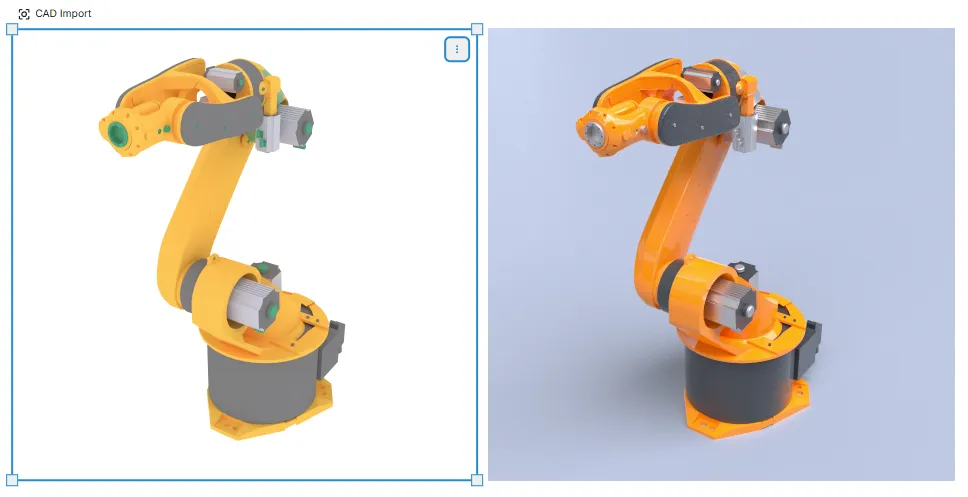
Aarhus, Denmark. Figurement announced expanded CAD import capabilities through an integration with RapidPipeline, allowing product teams to bring engineering defined product data directly into Figurement’s cloud based collaborative photorealistic visualization workspace.
Turning Engineering Data Into Usable Product Visuals
For most companies, CAD already defines what the product is. The challenge has been turning that data into visuals that teams can actually work with. Traditionally this required export pipelines, specialist rendering tools, manual scene rebuilding, and repeated render requests every time a material, color, or configuration changed.
Figurement is designed to make real product data usable for visual comparison, exploration, and decision making across teams and organizations.
Expanded CAD Accessibility Through RapidPipeline
With the RapidPipeline integration, Figurement expands its ability to reliably ingest engineering CAD data across a broad set of industry formats as well as optimized geometry processing.
Once imported, product data becomes available inside Figurement’s collaborative photorealistic workspace, where teams can explore configurations, compare material and color options under identical visual conditions, and make product decisions without waiting for new render cycles.
Figurement now supports more than 50 CAD and 3D pipeline import formats connected to major industry CAD ecosystems, including data originating from leading engineering platforms such as:
- SolidWorks
- Creo
- CATIA
- NX
- Rhino
- Inventor
- Solid Edge
As well as geometry kernel and technical CAD foundations including:
- Parasolid based systems
- ACIS based systems
Modern scene description and pipeline formats including open standards such as:
- USD (Universal Scene Description)
Enabling Configuration Driven Product Decisions
This becomes critical as products become increasingly configuration driven. Instead of generating separate renders for each option, teams can evaluate product variants side by side using the same camera, lighting, and environment.
This removes visual bias, reduces iteration cycles, and allows product decisions to happen earlier and with greater confidence.
By combining broad CAD accessibility with cloud rendering, collaborative workflows, material and color libraries, and physically accurate rendering, Figurement enables teams to:
- Generate photorealistic visuals directly from engineering product definition
- Compare product variants under identical visual conditions
- Give more teams access to trustworthy product visuals
- Align design, engineering, product, and commercial teams around the same visual reference
- Reuse product visuals from concept exploration through final marketing imagery
Engineering data already defines the product. The challenge has been making that product visually understandable across teams. When teams can see real product options side by side under identical conditions, conversations change. Decisions happen faster. And fewer decisions have to be revisited later.
Jesper Mosegaard, Founder and CEO of Figurement
Combining Physically Accurate Rendering and AI Assisted Editing
The RapidPipeline integration further strengthens Figurement’s ability to combine physically accurate rendering with AI assisted visual editing. This allows teams to maintain material and color trust while accelerating visual exploration and downstream content creation.
The expanded CAD import capabilities are available today for customers and pilot partners.
About Figurement
Figurement is a cloud based collaborative photorealistic product visualization workspace built around real product data. The platform connects engineering geometry, photorealistic rendering, AI assisted editing, and multi user collaboration into a single cloud workflow, enabling teams to explore, compare, and make decisions on product visuals across the full product lifecycle.
3D robot arm model by iucc92, CGtrader. Product names and trademarks mentioned are the property of their respective owners and are used for identification purposes only.